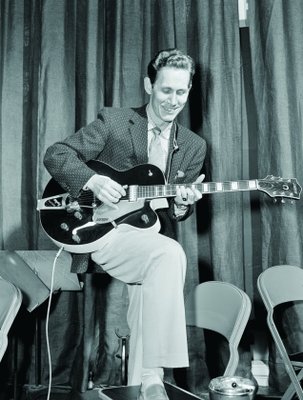
- This photo taken of Chet Atkins backstage at the Grand Ole Opry shows what is likely the black 6120 in a very early incarnation. Note the short Gretsch pickguard, the Ray Butts-designed Filter’tron humbucking prototype pickups, the unfinished (or possibly white) sides, and the “bent wire” Bigsby arm. The white simulated f-holes appear to be glued-on templates, featuring a slimmed-down design that Atkins traced from his D’Angelico. Several features like the horseshoe headstock horseshoe, block fingerboard inlays, and early bar bridge are identical to those seen in later photos of the black 6120.
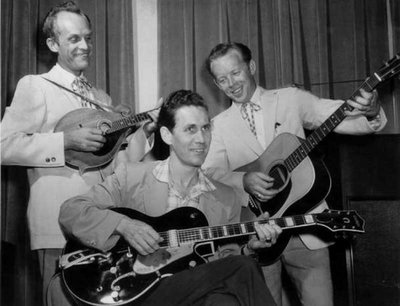
- Although the previous photo is dated September, 1956, the date is likely an error as this photo of Atkins with the black 6120 with later modifications taken with the Louvin Brothers is dated August 18, 1956. Note the swing-away, flat handle Bigsby arm, black finished sides, longer Gretsch Chet Atkins “signpost” pickguard, and the toggle switch mounted where the bridge pickup volume control used to be. The f-holes are now standard large Gretsch-style simulated f-holes made of gold sparkle Nitron.
I believe the dates are correct on the photos. Chet was wanting to get away from the cowboy "Western" items on his guitars, so the pickguard without the sign-post would be a later guitar. He also didn't like the big gaudy f-holes, so it makes sense that the Sept 1956 photo with the smaller f-holes and plain Gretsch pickguard is a later model guitar than the solid black Dark Eyes guitar. It's also my belief that the 3 guitars starting with the orange guitar that had the solid top, then the Dark Eyes guitar, and then the black top light sides guitar, were all prototypes that eventually lead to the Country Gentleman. Each had changes that evolved into what Chet was really looking for in a guitar.
 Posted: Sat Aug 24, 2013 12:19 pm